
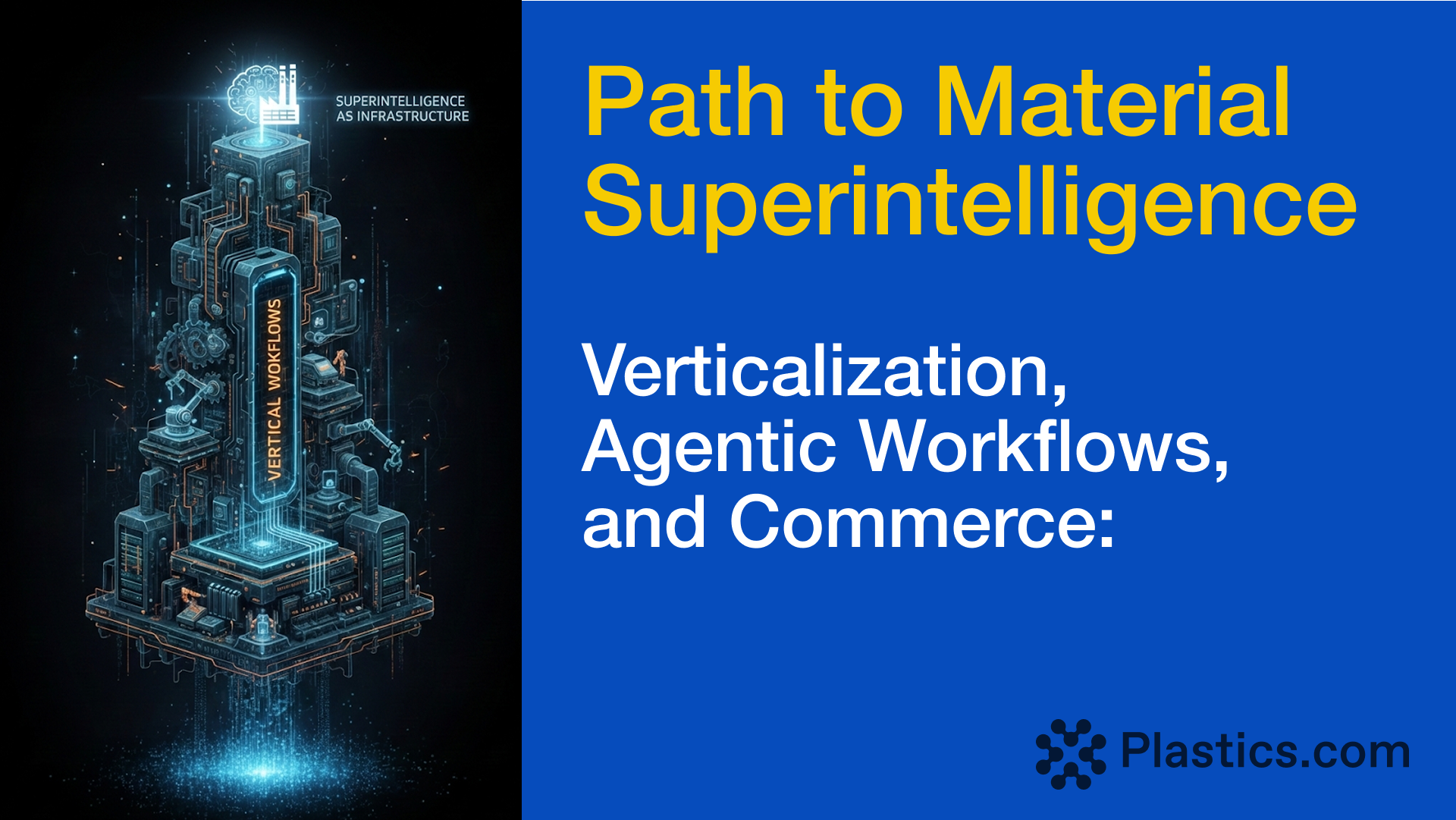
Superintelligence in the Materials Industry
Superintelligence will emerge from vertical AI infrastructure rather than general-purpose models. The plastics industry is fragmented, with material data spread across PDFs, supplier websites, proprietary databases, and inconsistent test conditions—forcing engineers to make high-stakes decisions without a shared system of record.
By transforming fragmented tools into integrated infrastructure, Plastics.com enables agentic commerce—where AI systems move beyond recommendations to execute sampling, quoting, ordering, and supplier coordination within governed frameworks. This vertical AI approach reduces systemic risk, improves traceability, and allows intelligence to compound safely over time.
As in many materials industries, plastics engineering illustrates why superintelligence will emerge through vertical systems rather than general-purpose models.
The plastics industry operates under extreme data fragmentation. Material properties are scattered across PDFs, proprietary databases, marketing collateral, supplier websites, and tacit human expertise. Even widely used materials lack standardized representations across suppliers, test conditions, processing assumptions, and regulatory regimes. Engineers routinely make decisions using incomplete, inconsistent, or unverifiable data—not because better reasoning is unavailable, but because no shared system of record exists.
This is the constraint Plastics.com is designed to address.
Plastics.com is powered by Herman AI, an agentic intelligence layer purpose-built for materials engineering and industrial commerce. Herman AI is not a general-purpose assistant or copilot. It is a vertically trained system that reasons over structured materials data, maintains long-horizon memory across decisions, and operates within explicit technical, commercial, and regulatory constraints. Where Plastics.com defines the operational surface, Herman AI provides the decision-making substrate that allows that surface to compound intelligence over time.
Rather than treating search, education, specification, and procurement as separate problems, Plastics.com collapses them into a single operational surface. Material discovery, technical validation, supplier qualification, and transaction are no longer sequential handoffs across disconnected tools. They become a continuous, auditable workflow in which decisions persist, accumulate context, and produce observable downstream effects.
From an AI systems perspective, several implications follow.
First: overcoming data sparsity requires structure, not scale.
General models struggle in domains where the long tail dominates and ground truth is conditional. Plastics.com explicitly structures materials data, i.e. normalizing units, test methods, processing states, regulatory attributes, and application constraints, so agentic systems can reason over comparable representations rather than raw text. The system does not merely retrieve information; it encodes the assumptions under which that information is valid.
Second: search and education must converge into a single source of truth.
In industrial domains, learning and deciding cannot be separated. Engineers evaluate materials while designing parts; procurement teams validate choices while negotiating supply; suppliers respond within technical and commercial constraints. Plastics.com treats education, comparison, and decision-making as a unified process, allowing the underlying agentic intelligence to accumulate long-horizon memory across queries, evaluations, and outcomes. Over time, this creates institutional memory that no standalone model can replicate.
Third: intelligence compounds only when embedded in real workflows.
Plastics decisions propagate into CAD designs, PLM systems, QMS platforms, CRM pipelines, supplier qualification processes, and manufacturing execution. Plastics.com is designed to integrate directly into these environments—not as a chat interface, but as a system that can read from and write to the tools where decisions already live. This allows agentic systems to act with awareness of geometry, lifecycle stage, customer commitments, and supply constraints.
Fourth: agentic behavior requires accountability.
Material selection errors are expensive. They result in tooling changes, failed qualification, regulatory exposure, and delayed launches. For agentic systems to act autonomously in regulated, physical domains, abstention, escalation, and traceability must be first-class behaviors. Knowing when not to act is as important as acting.
Risks Without Vertical Infrastructure
The absence of vertically integrated, infrastructure-grade AI systems does not result in stasis. It results in brittle automation, silent error propagation, and escalating systemic risk.
Intelligence without structure amplifies error.
General-purpose models applied to unstructured industrial data produce confident outputs built on unstable assumptions. In plastics, small inaccuracies—misinterpreted test conditions, incorrect filler content, overlooked compliance constraints—compound rapidly. Without explicit structure and provenance, failures quietly embed themselves in downstream workflows.
Copilots increase speed without increasing responsibility.
Standalone AI tools optimize for responsiveness, not ownership. They assist individuals but lack continuity across teams and time. As these tools accelerate material selection and supplier engagement without persistent memory or auditability, organizations move faster while becoming less certain about why decisions were made or who owns the consequences.
Fragmented adoption breaks feedback loops.
When AI is introduced piecemeal—search in one tool, analysis in another, procurement in a third—no system observes the full decision lifecycle. Failures cannot be traced. Lessons are relearned repeatedly. Intelligence remains local while risk becomes systemic.
Lack of workflow integration blocks learning.
AI systems that are not embedded into CAD, PLM, and manufacturing environments see queries but not outcomes. They do not observe what was built, qualified, rejected, or recalled. Apparent intelligence improves, but real-world performance plateaus.
Organizations outsource judgment without building control.
As AI outputs become more persuasive, teams defer decisions without upgrading governance. This creates a dangerous asymmetry: increasing reliance paired with decreasing visibility. In physical and regulated domains, this gap is where failures become existential.
These failure modes clarify a core point: superintelligence cannot be layered onto existing workflows as an interface upgrade. Without vertical infrastructure, intelligence becomes volatile. With it, intelligence compounds safely.
Ultimate Transformation: From Agentic Workflows to Agentic Commerce
What emerges next is not merely better decision support, but a new class of systems capable of executing economic activity.
Once agentic systems are embedded across discovery, evaluation, specification, supplier qualification, and transaction, a threshold is crossed. Decisions no longer terminate at recommendations. They initiate actions: sampling, quoting, ordering, and logistics coordination, within predefined constraints and governance frameworks.
This is the transition from agentic workflows to agentic commerce.
In this future, agents do not simply advise engineers which material to choose. They understand design intent, verify technical feasibility, identify qualified suppliers, negotiate within approved bounds, place orders, and monitor execution, while maintaining persistent memory of decisions, outcomes, and exceptions. Humans remain in the loop, but no longer in every step.
Within Plastics.com, this execution layer is mediated by Herman AI, which operates under explicit technical assumptions, commercial guardrails, and escalation thresholds to ensure that autonomy increases reliability rather than risk.
Superintelligence, in this framing, is not a moment when models suddenly reason better than humans. It is the point at which vertically integrated systems can coordinate complex decisions, transactions, and physical outcomes more reliably than fragmented human processes.
Plastics.com is being built with this trajectory in mind, not as an AI application, but as durable industrial infrastructure. Herman AI is the compounding intelligence within that infrastructure, learning from every evaluation, transaction, exception, and outcome.
Superintelligence will not arrive as a discrete event. It will appear incrementally. At Plastics.com, we are working with over 300 companies to build Herman AI systems to progressively simplify the complex plastics supply chain.
For builders, the question is not when superintelligence arrives, but whether the systems being built are capable of evolving from tools to workflows to infrastructure.

Core insights building a Vertical AI factory
We get a lot of questions about why users find that Herman AI at Plastics.com provides them so much more value than generic LLMs. While the difference might seem like AI jargon, in that Herman AI isn’t a prompt, but a buzzy verticalized Agentic AI tool, the real advantage has been our focus on tight embedding of our AI factory architecture into our plastics sourcing platform, so that our platform is autonomously improving, delivering a seamless sourcing experience.
Plastics is a ~$600B global market where material decisions still rely on fragmented PDFs, tribal knowledge, and disconnected tools. Engineers are expected to move faster, reduce risk, and meet rising cost and sustainability constraints, yet the underlying systems for researching, specifying, and sourcing materials haven’t meaningfully evolved in decades.
Over the last year, we’ve been building Herman AI at Plastics.com, a vertical AI sourcing platform purpose-built for plastics and materials engineering. Today, Herman can reference over 46,000 plastics, over 100,000 pages of expert engineering knowledge, and 10,000 categorized plastics industry websites, enabling engineers to research, evaluate, and order materials in a single workflow. Since last October, Herman’s usage has grown ~40% month-over-month to >300 companies, helping engineers find materials 3× faster and enabling teams to receive quotes from 100+ suppliers within 24 hours.
Along the way, we’ve gained hard-earned insights into the limits of LLMs while solving those challenges with AI agents embedded in real engineering and procurement workflows.
First: The GPT-style user experience isn’t enough.
A simple chat interface breaks down quickly in B2B engineering environments. Engineers and procurement teams need collaboration, shared analysis, versioned decisions, integrations with specialized tools, and support for real workflows—not isolated prompts and answers.
Our answer was to embed Herman into a custom-built marketplace that seamlessly connects engineers to suppliers on Plastics.com.
Second: Engineers need workflow completion, not isolated tasks
Most frontier AI tools today optimize for individual moments: answer a question, or summarize a document. That’s useful—but it’s not how engineering work actually happens.
AI for engineering must be designed around end-to-end workflow completion with high trust, not prompt-level intelligence. Memory, project structure, collaboration, and system integrations matter as much as model quality. In practice, this means building AI that behaves less like a chatbot and more like a continuously running process that is embedded across engineering and sourcing workflows.
Third: an ontology is necessary, but nowhere near sufficient.
Domain structure matters. You need a shared language for materials, properties, processes, suppliers, test methods, and trade-offs. But an ontology alone doesn’t tell you what matters, what’s credible, or what to recommend in a specific engineering context.
That’s where three things became critical for us:
1. Material Rank
Engineers don’t just need results; they need prioritized results. Material Rank encodes relevance, applicability, supplier credibility, performance fit, and real-world usage signals. Without ranking, AI outputs feel impressive but unusable. With it, engineers move faster and trust the system.
2. Engineering Knowledge (not just data)
Datasheets are incomplete, inconsistent, and often contradictory. Engineering knowledge lives in the gaps: how properties interact, what fails in production, which substitutions actually work, and where risk hides. Capturing and operationalizing that requires more than retrieval—it requires reasoning grounded in domain context.
3. Engineering Memory
Engineering work is cumulative. Decisions depend on past constraints, prior failures, approved materials, internal standards, and supplier relationships. We’re building engineering memory alongside our ontology so Herman can remember why a decision was made—not just what was selected—while keeping that memory private and customer-controlled.
The bigger realization: Vertical AI isn’t a prompt. It’s an AI factory.
To make this work, we’ve had to build infrastructure that spans:
· query decomposition, intent identification, and orchestration
· multimodal domain knowledge processing and encoding pipelines
· ontology enrichment using physics-based and genetically optimized ML
· multimodal graph retrieval of domain knowledge
· private, contextual memory
· engineering-specific evaluation frameworks
· and custom RL models embedded directly into workflows
Turning natural language into reliable, repeatable engineering outcomes requires policies, guardrails, evaluations, and constant feedback loops. Agentic AI only works when the system knows when not to answer, when to ask clarifying questions, and how to reason inside domain constraints.
How are we doing:
Plastics.com delivers value to our customers by directly integrating Herman AI into their engineering and procurement workflows. Customers trust our verticalized agentic AI platform because we outperform frontier models by around 48% across expert-graded and evaluated NCEES plastics-related engineering questions, has 20% lower hallucination rates, and are 12.8x faster when answering engineering-related questions.
The payoff:
This approach lets us rapidly innovate, increase data leverage, and refine our strategies as new foundation models emerge, without rewriting the product, which continuously improves accuracy, trust, and speed for engineers sourcing real materials under real constraints.
Where are we going:
We’re focused on reducing friction in agent-based transactions and logistics by using AI to deeply integrate existing engineering, procurement, and supplier workflows. We’re also excited to be launching agentic simulation, cost analysis, and CAD tools purpose-built to make designing complex plastic parts easier for the 45M CAD users worldwide. Our team is striving to make the world a better place through greater education about sustainable options, bringing the tool to other verticals.
Vertical AI is harder than it looks.
But when it’s done right, it stops being a demo—and starts becoming infrastructure.
We built Herman AI for engineers → Plastics.com for procurement → Workflows to become infrastructure.
Author: Dale Thomas, CEO